
Finding the Giants: My Journey with Michael Taylor
By Maria Mircheva, Part 1 of a 2-part series
Michael Taylor is a renowned "big tree hunter," best known for co-discovering the world’s tallest trees—including "Hyperion," the coast redwood that took the title of the world's tallest known tree in 2006. Alongside his colleagues Chris Atkins and Steve Sillett, Michael has identified hundreds of specimens over 350 feet tall, primarily hidden in the rugged wilds of Northern California. Today, he also serves as a valued Advisor for our Sugar Pine Foundation Board of Directors.
Michael believes that discovering these giants—which represent a "boundary condition" for the species—teaches us invaluable lessons about the best conditions for growing healthy forests. For Michael, and for most of us who follow him, standing beside these titans is a humbling, mesmerizing experience.
Michael has been involved with the Sugar Pine Foundation for over a decade. A tireless researcher, he discovered our small Tahoe-based organization online and contacted me in 2010. Shortly after, he mailed me some of his favorite books, including Forest Giants of the Pacific Coast by Robert Van Pelt and The Wild Trees by Richard Preston. Both books chronicle the discovery of the world's tallest trees, a narrative in which Michael plays a central role.
In The Wild Trees, Preston tells the story of the "big tree hunters." While the book features heart-pounding stories of researchers like Steve Sillett and Marie Antoine discovering entire "islands" of vegetation high in the canopy, Michael’s role is more subdued but no less vital. He is a warrior on the ground—a math whiz and skillful bushwhacker who sifts through LiDAR data and "ground-truths" discoveries through grueling hikes. His character isn't driven by fame, but by a tireless pursuit—grinding through data to find a needle in a haystack. Finding the world’s biggest trees is truly Michael’s unique gift and his destiny.
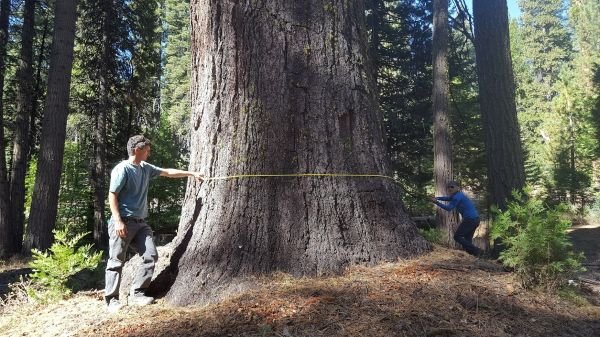
Measuring the diameter at breast height (dbh) of a sugar pine tree
One of the most famous trees in the Forest Giants book was the Whelan Tree near Dorrington, once the largest sugar pine on record. In 2014, Michael heard it was dying and asked if we could help. I headed to the site with Tyler, owner of Alpine Arborists and a fellow tree lover from Truckee. Unfortunately, the giant was too far gone. It had likely been infected by white pine blister rust first, followed by turpentine beetle attacks at its base and mountain pine beetle holes along its trunk. Only one large branch remained alive. Michael and Bill Werner, a botanist for Archangel Ancient Tree Archive, visited the tree to fetch live samples for cloning, but sadly, they were not successful. This was probably due to the cuttings from the last living branch being already infected with blister rust.
By now, the top five largest sugar pines featured in the book—the Whelan, Pickering Pine, Calaveras Colossus, One-Armed Bandit, and the Yosemite Giant—are all dead. This loss is a stark testament to the rapid decline of the species. Primarily driven by the invasive pathogen white pine blister rust, severe drought, and relentless attacks by the mountain pine beetle, our sugar pines are facing an uphill battle. Compounded by climate change, decades of fire suppression, and past logging, these stressors have significantly reduced the species' density and health across the range. Even the survivors aren't safe; recent extreme wind storms have toppled several of the remaining giants. Studies indicate that sugar pine density has declined by more than 50 percent in some areas over the past two decades.
After the Whelan Tree died, Michael and I met at Camp Sugar Pine in the spring of 2015 to assess the stump. I had my five- and seven-year-old children with me, who were happily exploring the forest. Michael pulled out a set of ̶push pins and began meticulously marking the rings, placing a pin at every 10-year interval. We counted 614 rings. It is difficult to fathom such a lifespan; to put it in perspective, that tree had already been alive for a century before Columbus sailed for the Americas.
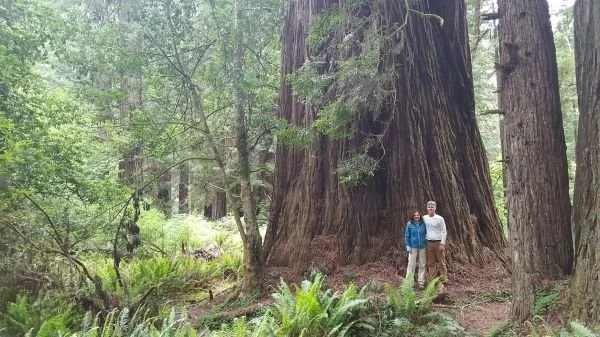
A few years later, Michael gave me a personal tour of the world's tallest redwoods, stretching from the Rockefeller Forest to Jedediah Smith. It was incredible to see the variety: from the drier southern forests with sparse ground cover to the northern groves where head-high ferns thrive in the mist. We even saw an "albino redwood"—a white-needled mutation that lacks chlorophyll and acts as a parasite to its mother tree. Interestingly, these albinos have the ability to accumulate toxic metals, which could one day serve as a tool for soil remediation. Throughout the trip, Michael swore me to secrecy regarding the locations, as these ancient trees are often "loved to death" by crowds.
Since then, I have joined Michael on numerous ground-truthing expeditions marked by steep canyons, bee stings, and wild river crossings. These last few giants survived the axes of early loggers only because they were so difficult to access. They are usually found near creeks or meadows with a steady water source to feed their enormous growth. In striving for light, they often lean over canyons, which makes the mathematical task of measuring their true height even more complex.
Tree hunters used to name their champions—giving redwoods Greek names like Helios, Icarus, and Daedalus. I even got to help name the fourth-tallest sugar pine in Yosemite: the "Creek Tapper." However, the community has largely abandoned this practice to protect these remarkable specimens as giving them names turns them into celebrities that inspire others to seek them out. Today, we keep their locations quiet because, all too often, visitors inadvertently kill the trees they admire by trampling the delicate root systems or spreading infections on their shoes.
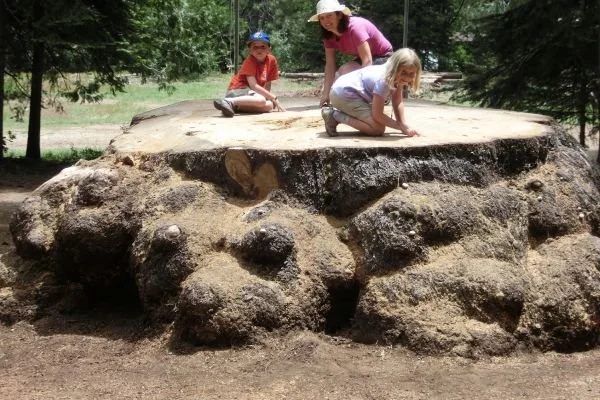
Maria & her children counting growth rings on the Whelan stump
1458 Mt. Rainier Drive, South Lake Tahoe, CA 96150 | (650) 814-nine565 | admin@sugarpinefoundation.org
