
Michael Taylor is currently on a mission to identify the absolute tallest specimens of the Pacific Northwest’s primary conifers. His "Target 10" species list includes the Incense Cedar, White Fir, Sugar Pine, Jeffrey Pine, Ponderosa Pine, Douglas Fir, Red Fir, Sitka Spruce, Coast Redwood, and Giant Sequoia. He is also cataloging the region’s tallest Valley Oaks and Eucalyptus. To date, Michael has cataloged the top 50 tallest individuals of each species and is now in the final phase of "ground-truthing" the top 10. For more information about his field work, check out Part 1 in our February newsletter.
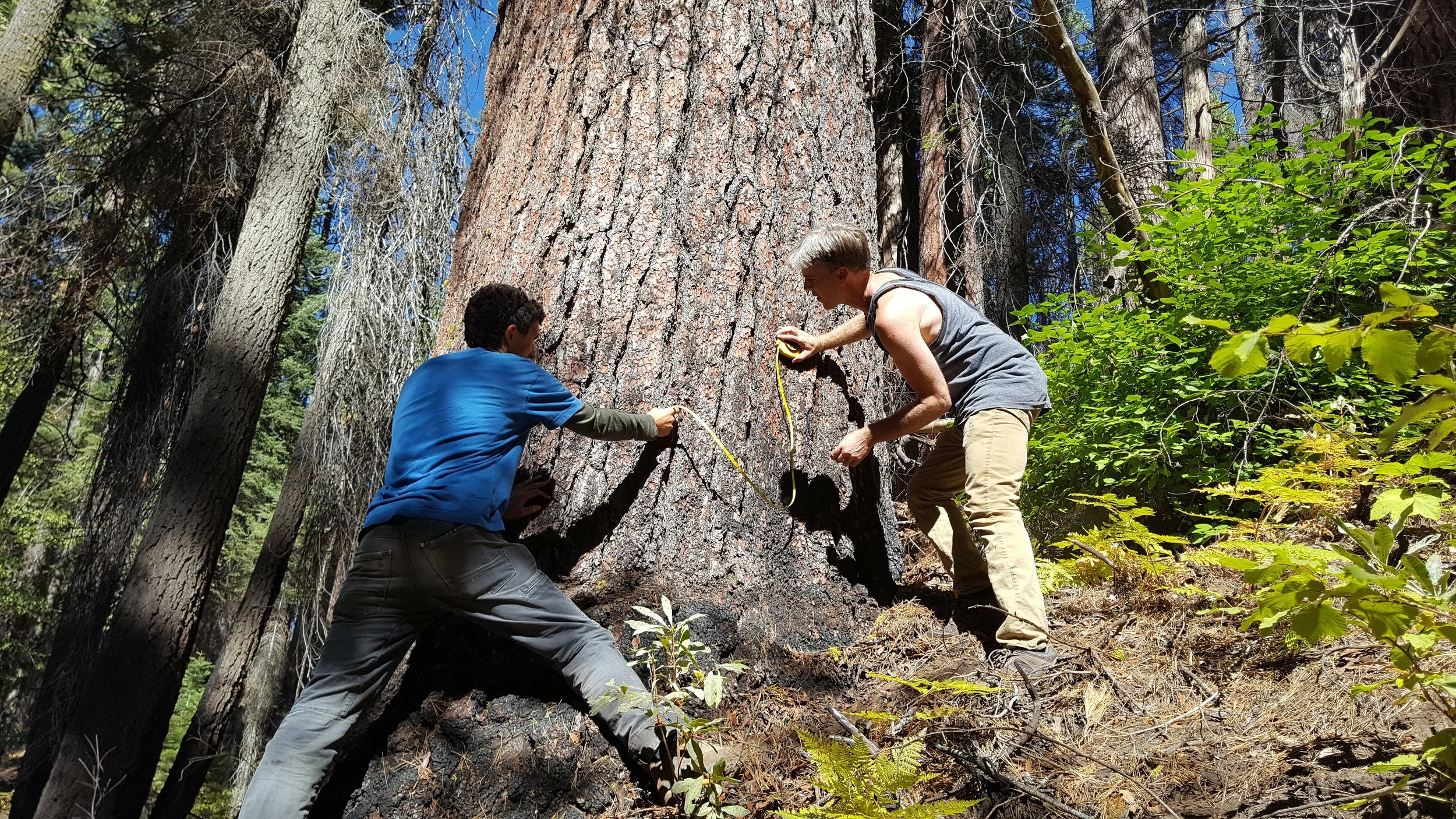
Michael and his friend Ben measuring diameter breast height of a tall sugar pine in Yosemite
The Digital Forest
Michael’s hunt begins not in the woods, but on a computer. He has amassed over 200 terabytes of processed LiDAR (Light Detection and Ranging) data. By measuring the time it takes for laser pulses to bounce from an aircraft to the forest floor, LiDAR creates a precise 3D map of the canopy. Michael extracts images from this data, averages the high and low ground points of a trunk, and calculates the distance to the tip.
"After finding the top 50 of each target tree, I head out to ground-truth the top 10," Michael explains. This field verification is essential to confirm that the laser didn't misidentify a species or hit a "ghost" point in the data.
The Evolution of the Hunt
In the early days, Michael relied on a clinometer and tape line—a method prone to error and physical exhaustion. "Measuring a tree accurately was nearly impossible until reflectorless laser rangefinders became affordable," he notes. Today, he uses high-end, handheld forestry lasers to confirm his LiDAR findings.
Unsurprisingly, the giants are most concentrated in California’s northernmost reaches—Del Norte and Siskiyou counties—though central and Southern California still hold "surprising jewels." These champions are almost always remote, near meadows or tapping into hidden creeks to fuel their massive growth.
The 2026 Final Push
This year marks the final year of Michael's current contract. Only a few remote locations remain on his list: the Smith River in Del Norte, Marble Mountain Wilderness in Siskiyou, and Piru Creek in the Santa Ynez Mountains.
Field Notes by Species:
Coast Redwoods: Michael recently re-measured Hyperion at 381.3 feet. However, its neighbor Helios (378.8 ft) is growing faster; Michael predicts it will take the title of "World's Tallest" within 15 years.
Giant Sequoia: Recent wildfires have been devastating to this species, but Michael identified a 316-foot giant standing near the famous General Sherman.
Douglas Fir: The "holy grail" is a 327.5-foot specimen, near Eugene, Oregon. A tree in Redwood National Park that stands 326-feet is currently the closest contender. Another giant doug fir, over 330-feet grew in Hand Creek Oregon but recently lost its top.
Ponderosa Pine: A tree in Stanislaus National Forest holds the current record at 276 feet. However, Michael has his sights on a potential 275-foot+ Ponderosa in remote Siskiyou County. Reaching it requires descending a 7,000-foot ridge into a trail-less 3,500-foot valley—a "Type 2 fun" adventure that his fellow tree hunters have declined.
Jeffrey Pine: Exceptional individuals over 230 feet can be found between Highway 88 and Pinecrest. Michael notes that Jeffreys are currently outpacing Ponderosas in growth speed.
Sugar Pine: The tallest reaches about 273.5 feet in Yosemite and there are some giants along the California coast ranges. On a recent grueling bushwhack near Oregon’s Applegate Reservoir, Michael arrived only to find his target tree, a 272-foot sugar pine, had fallen just a month prior.
Incense Cedar: These rarely top 200 feet, with the champions residing along the California-Oregon border. The tallest known is currently 221-feet.
White Fir: While the tallest are in Del Norte, a massive survivor standing 266-feet in El Dorado County gained attention recently for surviving the Caldor Fire.
Red Fir: Michael located a 253-foot specimen near Shaver Lake, but it has a dead top. Red Firs are struggling in California, falling victim to drought, fir engraver beetles, and overcrowding—a sign they are ill-adapted to our warming climate.
Sitka Spruce: While Washington is known for these, California holds the tallest. Prairie Creek Redwoods State Park has one that stands 328.5-feet. Redwood National Park hosts a 324-foot specimen with a staggering 11-foot diameter at breast height.
