
Forests of the Future
PLANTING THE FORESTS OF THE FUTURE: LESSONS FROM THE FIELD
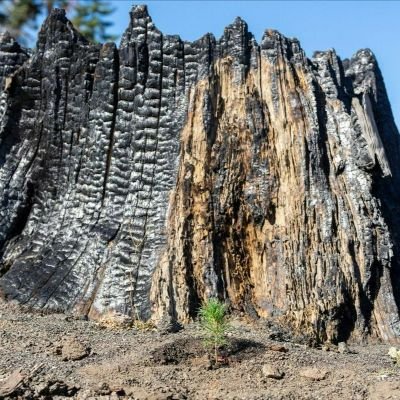
The Caldor Fire left us with an undeniable wound but spurred an opportunity to restore the forests to a more climate adapted ecosystem. Thousands of acres burned through in 2021, killing trees and decimating the natural seedbank, thereby limiting the forests’ ability to recover. This spring we worked to reforest areas recreational sites such as along Fountain Place Road, aroun Echo Lake and below Lovers Leap, 100 + acres between 5,000 and 8,000 feet.
Without active replanting, much of it faces the real threat of converting to a shrubland. We’ve witnessed the loss of a forest to an impenetrable thicket of whitethorn on Angora Ridge after the 2007 fire. We don’t want a big part of the Caldor Fire burn scar to suffer a similar fate. Our efforts to restore this fragile ecosystem is a contribution that will outlive our generation but will not be possible without our intervention.
The deep, slow-melting snowpack that historically kept soils moist through June, that critical window when seedling roots are still shallow and vulnerable, is becoming shorter and less reliable every decade. A planting plan that ignores this pattern is planting for a world that may not exist by the time those trees reach maturity.
To give seedlings the best opportunity on each site, we're making a few deliberate departures from historical species composition. We are increasing the proportion of Jeffrey pines since our region is prone to drought and a deep taproot is an adaptation that gives them an advantage to survive longer, drier summers. Sugar pine — our foundation species and the heart of this organization's mission — is being prioritized on north and northeast aspects, where moisture is more abundant.
Milder winters create more favorable conditions for blister rust to spread, so we only plant rust-resistant sugar and western white pine, a proactive strategy to ensure the long-term survival of these trees in favorable microsites. In the upper elevations above 7,300 feet, we're moderating our red fir and western white pine plantings by leveraging topographic features - north-facing slopes, shaded benches, the upper edges of drainages- to buffer against escalating temperatures and drought stress.
Perhaps the most important principle guiding this plan is that we are not trying to recreate the forest that was there before, instead, we're cultivating a forest diverse and resilient enough to adapt to future conditions we can't fully predict. That means planting a genuine mix of species and spacing seedlings farther apart to minimize future competition for water. It also means taking the summer watering program seriously. Our data confirms that monthly watering during the critical first 2-3 years boosts survival rate by 50%. On highly exposed ricky sites without canopy cover, this extra care is the deciding factor between long-term establishment and total mortality.
The trees planted this spring won't be a mature forest in our lifetimes. But they will decide whether this hillside becomes a forest or shrubland, whether the soil stays intact through the next fire cycle, and whether the next generation of Tahoe residents inherit a living forest or a legacy of missed opportunity. We're planting for them, and for the conditions they'll face — not the ones we grew up with.
1458 Mt. Rainier Drive, South Lake Tahoe, CA 96150 | (650) 814-nine565 | admin@sugarpinefoundation.org
